
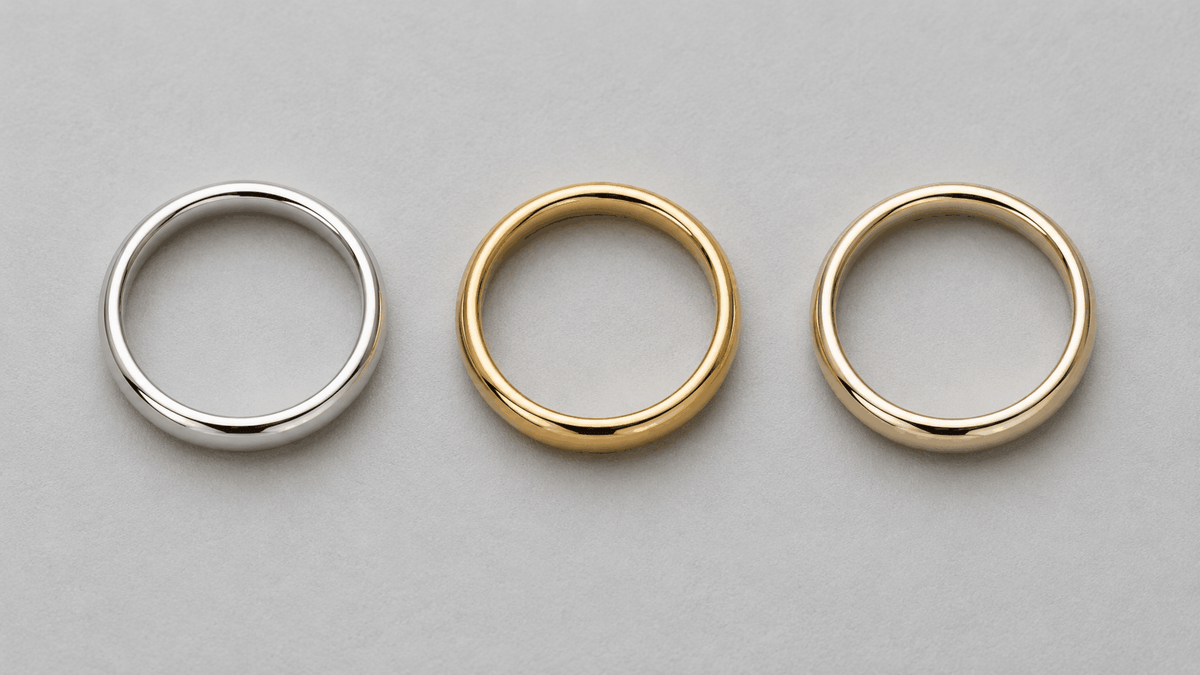
925 Sterling Silver vs. 18K Gold-Plated vs. Gold Vermeil: What's the Real Difference
Gold-plated, gold vermeil, and gold-filled get used almost interchangeably in jewelry marketing, which is convenient for sellers and unhelpful for you: they're three different constructions with meaningfully different lifespans, and one of them is the only one with an actual legal definition in the US.
Gold vermeil: the one with a legal definition
Under the FTC's Jewelry Guides (16 CFR Part 23), a piece can only be legally labeled "gold vermeil" in the US if it meets three conditions at once: the base metal is sterling silver, the gold layer is at least 10 karat purity, and the gold plating is at least 2.5 microns thick. A human hair is roughly 70 microns thick for scale: 2.5 microns is still thin, but it's a defined, enforceable minimum, and mislabeling something as vermeil without meeting it is a violation of FTC guidelines, not just a marketing fudge.
Gold-plated: the same idea, no minimum
Plain "gold-plated" jewelry has no legal minimum thickness at all, and no requirement about what base metal sits underneath: it can be sterling silver, brass, stainless steel, or another alloy. In practice, plating thickness on the market ranges enormously: flash plating can be under 0.2 microns and start fading within a few months, while heavier plating in the 1.5–2.5 micron range holds up closer to a year or two. Nothing about the term "gold-plated" alone tells you which end of that range you're getting; the base metal and the actual thickness (rarely published) matter far more than the label.
Gold-filled: the thickest layer, mechanically bonded
Gold-filled construction is different again: a layer of gold (required to be at least 5% of the item's total weight) is mechanically bonded to a base metal under heat and pressure, rather than electroplated on. That much more gold, bonded rather than plated, is why gold-filled jewelry typically lasts significantly longer than either plated or vermeil pieces with reasonable care: commonly cited lifespans run 5 to 30 years versus roughly 1 to 3 years for vermeil and considerably less for standard plating.
Where MIRNE fits
MIRNE's gold pieces are 18K gold-plated on the same 925 sterling silver bases used across the site, plated, not marketed as vermeil or gold-filled, and it's worth being precise about that rather than letting the terms blur together. That construction sits in the middle of the picture above: a real sterling silver base (better than an unknown base-metal alloy), 18K gold purity (high, since 18K is 75% pure gold), but a plated, not mechanically bonded, gold layer, which means it will wear over time in a way that gold-filled jewelry resists longer. This guide covers a realistic timeline for exactly that.
Sterling silver pieces without gold plating avoid this question entirely: the metal you see is the metal underneath, all the way down.
Browse all four categories with this in mind: Rings, Necklaces, Earrings, and Bracelets.
