
Hypoallergenic Jewelry 101: What "Nickel-Free" Actually Means for Sensitive Skin
If you've ever had a piece of jewelry turn your earlobe red, itchy, or sore (usually a day or two after putting it on, not immediately), you've almost certainly had a nickel reaction. It's the most common metal allergy there is, and it's exactly what "hypoallergenic" and "nickel-free" labels are trying to promise you won't happen. The problem is what those words are actually allowed to mean.
The regulatory gap most brands don't mention
In the European Union, nickel release from jewelry is legally capped: the EU Nickel Directive (tested under the EN 1811 standard) limits general skin contact to 0.5 micrograms per square centimeter per week, and pierced skin, earrings in particular, to a stricter 0.2 micrograms per square centimeter per week, since broken skin is more reactive than intact skin. A brand selling in the EU that calls something "nickel-free" is making a claim tied to an actual, testable legal limit.
The United States has no federal equivalent. "Hypoallergenic" and "nickel-free" are not regulated terms here: there's no government standard a brand has to meet, and no required test, to use either phrase. Some US brands voluntarily hold themselves to the EU's numbers anyway; many don't say either way. That's the real gap: the words look identical on a product page, but one version is backed by a legal threshold and one might not be backed by anything beyond the material itself.
Why ears are the most common trouble spot
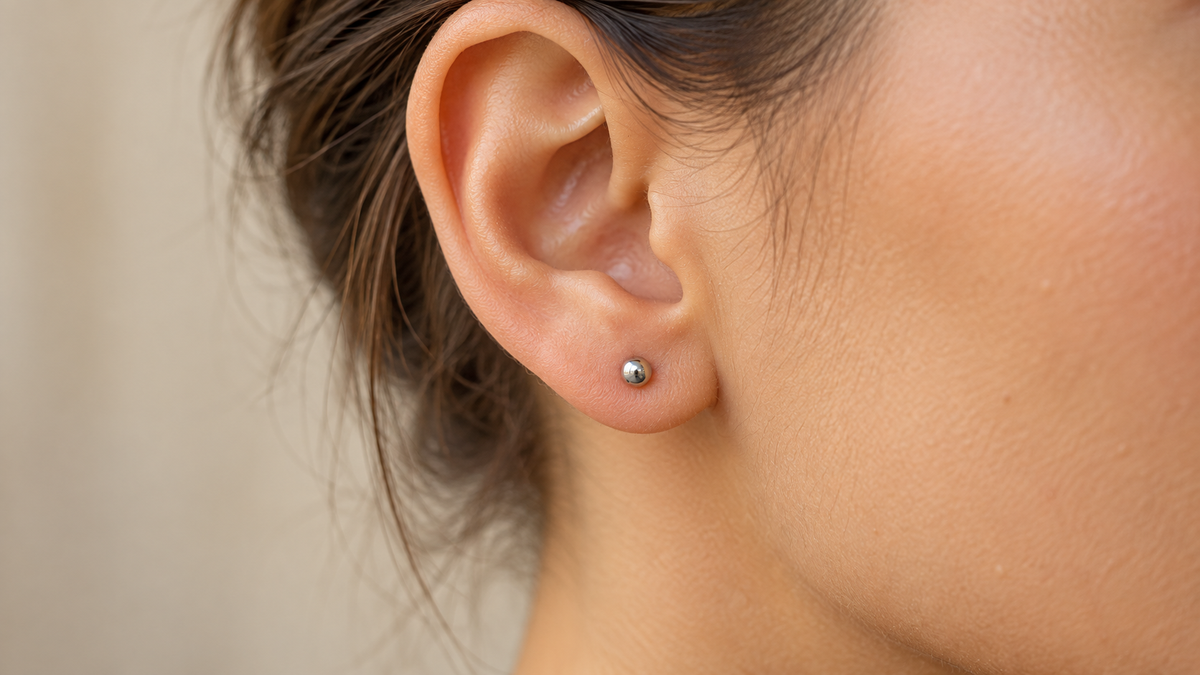
Pierced skin reacts faster and more severely than skin that's just in contact with metal, which is why earrings cause more nickel reactions than rings or bracelets even when it's the same base metal. Moisture, friction, and the fact that the metal sits inside a healing or semi-permanent piercing all increase how much nickel can transfer into skin over time. This is also why a piece that's fine on your wrist can still cause a reaction in your ear: it's not inconsistency, it's a different exposure situation entirely.
A well-known industry pattern worth knowing regardless of brand: a "nickel-free" surface coating over a base metal that still contains nickel. The coating tests clean on day one. Once it wears down, from normal friction, sweat, or repeated cleaning, the nickel-containing base underneath is exposed, and the reaction shows up months into wearing something that was accurately "nickel-free" when new.
What actually helps, regardless of brand
If you have a known or suspected nickel allergy: patch-test any new piece against a small area of skin for a full day before wearing it steadily, favor solid metals over plated ones where nickel sensitivity is a known issue (a coating is only as good as its thickness), and don't assume "hypoallergenic" on a US listing carries the same weight as it would on a EU one. Ask what's actually in the base metal if it matters to you.
MIRNE's sterling silver and 18K gold-plated pieces are built on 925 sterling silver and gold-plated bases rather than mixed base-metal alloys, and every item is tested before it ships, but that's a claim about material composition, not a specific third-party nickel-release lab result, and it's worth being precise about that distinction rather than letting "hypoallergenic" do more work than it's earned. The full breakdown of what's behind MIRNE's "Certified Authentic" badge is here.
Browse Earrings and Rings, the two categories where sensitive-skin questions come up most.
